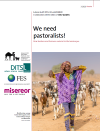
We need pastoralists! How herders and farmers sustain fertile landscapes

A dossier by LPP, DITSL, FES and MISEREOR in collaboration with the editors of Welt-Sichten This 20-page dossier, published by Misereor in collaboration with the League for Pastoral Peoples, DiTSL, the Foundation for Ecological Security and Welt-Sichten, focuses on how herders and farmers collaborate to sustain fertile landscapes. An estimated half a billion people worldwide depend on pastoralism for their livelihoods. Pastoralists keep around one billion animals, accounting for around half of the world’s livestock. They make a significant contribution to food security and the economiy by supplying milk, meat, hides, skins, and live animals for both domestic consumption and export.. Their mobile livestock production system enhances biodiversity on rangelands and sustains their function as carbon sinks. Articles Recognising Pastoralists’ Contributions; Pastoralists and Their Changing Relationship with Farmers: Camilla Toulmin The ABC of Pastoralism: Saverio Krätli On the Move: How Indian Pastoralists Sustain Food Production and Biodiversity: Ilse Köhler-Rollefson and Bhavana Kuchimanchi Poop to Pour Over! How Livestock Manure Helps Grow a Perfect Cup of Coffee: P.S. Madappa and Bhavana Kuchimanchi Beyond the Headlines: The Untold Story of Farmer-Herder Cooperation in Nigeria: Julia Krojer and Morenike Onaolapo ‘Our Cows and Your Crops Are Children of the Same Rain’: How Farmers and Herders Remained United: Andrew Msami and Dule Thadei Call to Action: Report on The African Pastoralist Gathering in Nairobi, January 2026: Saverio Krätli Pastoralists in Distress: What Needs to Be Done?: Rufo Roba Compagnone, Sabine Dorlöchter-Sulser, Ilse Köhler-Rollefson and Bhavana Kuchimanchi Download English German

Samburu community protocol

The Samburu community protocol about the Samburu indigenous livestock breeds and their rights to their indigenous livestock genetic resources and role in global biodiversity management. An articulation of the integral role of the breeds in Samburu culture and their importance to the world. It seeks to establish the significance of the Samburu way of life and the value of their indigenous breeds, and that as the keepers of important livestock populations they have a right to maintain their way of life. It clarifies for others on what terms they will permit activities to be undertaken on their land or regarding their indigenous breeds and traditional knowledge.

Community protocols for pastoralists and livestock keepers: Claiming rights under the Convention on Biological Diversity

Guide for livestock keepers and NGOs on how to claim rights by developing community protocols.A community protocol is a document, produced by a local community, about the biological diversity it creates and conserves. Community protocols are an important way for local people to claim their rights under national and international law, especially through the Nagoya Protocol to the Convention on Biological Diversity.This manual shows how pastoralists and other livestock-keeping communities can draw up a community protocol about their animal breed or production system. It describes why they should consider producing a community protocol, walks through the steps of doing so, and advices how to use the finished document. It explains in easy language the complex concepts of access and benefit sharing and how the community protocol can be used within the legal system.This manual is aimed at community leaders and organizations, nongovernment organizations and all those concerned with managing and conserving animal breeds and production systems.

Biocultural Community Protocol of the Camel Breeders of Rajasthan

The Biocultural Community Protocol of the camel breeders of Rajasthan puts on record the breeders' our role as a local community embodying a traditional lifestyle that is relevant for the conservation and sustainable use of biological diversity. The breeders have stewarded and taken care of Rajasthan’s camel population for generations and their traditional knowledge and practices as well as customary rights are the foundation of Rajasthan’s camel culture and biodiversity. This protocol describes the traditional knowledge that they have used to manage Rajasthan’s camel population over the last few centuries but which cannot be taught through books, only through practical experience.