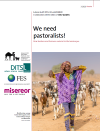
We need pastoralists! How herders and farmers sustain fertile landscapes

A dossier by LPP, DITSL, FES and MISEREOR in collaboration with the editors of Welt-Sichten This 20-page dossier, published by Misereor in collaboration with the League for Pastoral Peoples, DiTSL, the Foundation for Ecological Security and Welt-Sichten, focuses on how herders and farmers collaborate to sustain fertile landscapes. An estimated half a billion people worldwide depend on pastoralism for their livelihoods. Pastoralists keep around one billion animals, accounting for around half of the world’s livestock. They make a significant contribution to food security and the economiy by supplying milk, meat, hides, skins, and live animals for both domestic consumption and export.. Their mobile livestock production system enhances biodiversity on rangelands and sustains their function as carbon sinks. Articles Recognising Pastoralists’ Contributions; Pastoralists and Their Changing Relationship with Farmers: Camilla Toulmin The ABC of Pastoralism: Saverio Krätli On the Move: How Indian Pastoralists Sustain Food Production and Biodiversity: Ilse Köhler-Rollefson and Bhavana Kuchimanchi Poop to Pour Over! How Livestock Manure Helps Grow a Perfect Cup of Coffee: P.S. Madappa and Bhavana Kuchimanchi Beyond the Headlines: The Untold Story of Farmer-Herder Cooperation in Nigeria: Julia Krojer and Morenike Onaolapo ‘Our Cows and Your Crops Are Children of the Same Rain’: How Farmers and Herders Remained United: Andrew Msami and Dule Thadei Call to Action: Report on The African Pastoralist Gathering in Nairobi, January 2026: Saverio Krätli Pastoralists in Distress: What Needs to Be Done?: Rufo Roba Compagnone, Sabine Dorlöchter-Sulser, Ilse Köhler-Rollefson and Bhavana Kuchimanchi Download English German

Accounting for pastoralists in Mongolia

Rangelands cover 83% of Mongolia, and include steppes, deserts and mountain areas. Pastoralism supports over 250,000 herderhouseholds who herd 58 million livestock of five main species – Bactrian camels, cattle, goats, horses and sheep – plus some reindeerand yaks. Transhumant herders, predominantly Khalkha, account for 22.5% of the workforce and contribute around 7% of GDP. Harsh winters (dzuds) kill millions of animals. Some 70% of the country’s rangelands are degraded. Mongolia has relatively good data on pastoralism and rangelands, with some indicators down to the subdistrict level. But project-supported datasets are not integrated into these official databases. Pastoralism is an important part of Mongolia’s cultural identity. The government’s long-term development strategy aims to build on pastoralism to modernize the country’s economy and society.

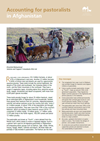
Accounting for pastoralists in Afghanistan

The rangelands that cover much of Afghanistan provide forage for livestock and support millions of pastoralists. Fully or partly nomadic pastoralists, known as “Kuchi”, make up around 10% of Afghanistan’s population. They migrate between summer pastures in the highlands and winter pastures in the lowlands. Some pastoralists have settled permanently and graze their animals year-round on communal pastures nearby. Others no longer own animals but retain their Kuchi identity. The pastoralists own more than 70% of the country’s livestock and produce most of the live animals and meat consumed there. Many pastoralists are poor and marginalized, lacking education, health and other services. Securing access to their traditional grazing lands is a major problem. Accurate, updated information on pastoralism is scarce. This hinders the design of policies and suitable interventions. A conducive socio-political environment and supportive policies are essential to ensure the sustainability of pastoralism.

With camelids into a sustainable future

The importance of camelid herders for the conservation of our world's rangelands is increasingly recognized internationally. To mark the International Year of Camelids, this thematic dossier introduces camelid pastoralists, how they sustainably manage rangelands in the Andean highlands, East Africa and Mongolia, and why the global community should support camelid pastoralism for a resilient future of our planet. Contents Allies for a green future - Igshaan Samuels and Maryam Niamir-Fuller Camelid husbandry worldwide - Bernard Faye Where in the world are camelids? - Paul Mundy New market opportunities in the Andes - Cecilia Turin and Mariana Quiroga Mendiola Camels as far as the eye can see - Piers Simpkin and Jacob Wanyama Proud to be a camel herder - Interview with Shariin Juu Participatory research for diversity - Ilse Köhler-Rollefson and Cecilia Turin The future of camelid husbandry - Ilse Köhler-Rollefson, Ann Waters-Bayer, Sabine Dorlöchter-Sulser and Cecilia Turin This dossier, co-published by Misereor, the League for Pastoral Peoples and DITSL, includes articles co-authored by LPP's Ilse Köhler-Rollefson, as well as several other articles by long-term collaborators with LPP. The centre spread is a poster showing the worldwide distribution of the seven camelid species (alpacas, Bactrians, dromedaries, llamas, guanacos, vicuñas and wild Bactrians (which have been recognized as a separate species from the domesticated Bactrians). This map is based on LPP's world Pastoralist Map. Download in English (from Misereor or LPP) or German (Misereor or LPP).