World map of yaks
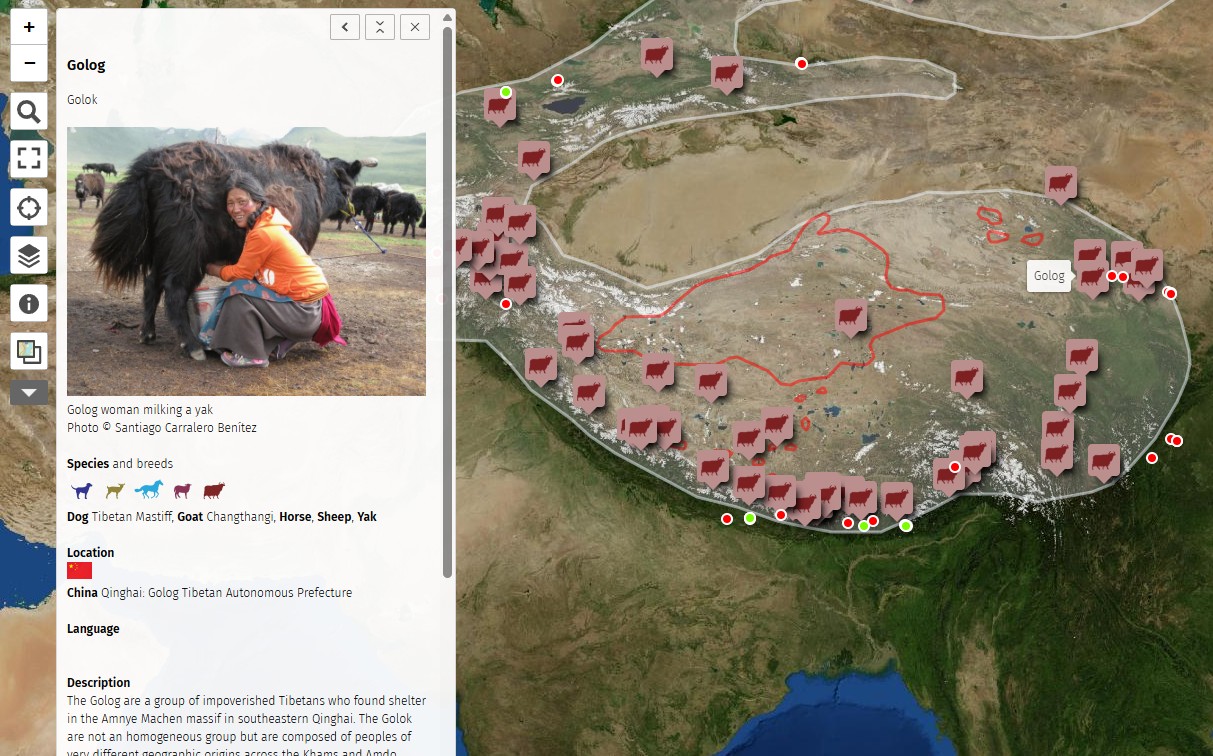
Our new world map of yaks shows around 70 pastoralist groups who keep yaks and nearly 50 organizations that are involved in yak research, development and support. The map also shows the approximate range of the domesticated yak (Bos grunniens) as well as the distribution of wild yaks (Bos mutus). Yaks are central to pastoral livelihoods in the cold, high mountains and plateaus of Central Asia, where few other livestock can thrive. There are about 14–15 million domestic yaks worldwide, with over 90% in China; Mongolia has around 600,000, with smaller populations in Bhutan, India, Kyrgyzstan, Nepal, Pakistan, Russia and Tajikistan. Yaks provide milk, butter and cheese, meat, wool and fibre, hides and skins. They are used as pack animals as well as for riding and draught power. Their dung is used as fertilizer and is an important fuel where wood is scarce. Yaks have also been introduced to North America, Europe and New Zealand, where they are also used for landscape maintenance. Special thanks to Professor Lóng Ruìjūn of Lanzhou University, China, for the initial idea for this map and for providing much of the information on which it is based. The world map of yaks is one of a series of maps of pastoralism prepared by the League for Pastoral Peoples and Endogenous Livestock Development. Other maps include pastoralist groups, threats to pastoralism, migration routes, videos on pastoralism and camelids.