Posters on pastoralism

These posters on pastoralism are suitable for display at conferences, exhibitions and open days. Each poster consists of an A4 landscape photo and and an A4 landscape text. The text is available in English, French, German, Spanish, Italian and Dutch. Combine each photo with the corresponding text in an A3 frame, or laminate them and hang them together. Feel free to change the photos or adapt the text as required. Please credit Paul Mundy/League for Pastoral Peoples, www.pastoralpeoples.org Download the posters.

Pastoralist quiz for children and adults

Here are plans for a quiz about pastoralists. It is designed for both children and adults. It can be used as part of a stand at a fair, in a classroom, or in a workshop or confewrence. You can use this quiz at various events: at discussion meetings, conferences, open days or exhibits. The aim is to inform and enthuse people about the diversity of, and services provided by, pastoralists worldwide. The child (or adult) takes a beanbag and throws it on the board covered with photos. The child must then answer one (or more) of the questions printed on the reverse of the photo card. Correct answers ear the child a prize (we use small packets of jellybabies in the form of sheep, obtainable here. The questions must be adapted to the age of the child or the background of the adult. Of course, every child wins a prize. You can make the board from a piece of plywood. If this is not possible, you can spread the photos out on the floor instead. Feel free to add to or adapt this quiz to your own situation. Please cite Paul Mundy/League for Pastoral Peoples, www.pastoralpeoples.org Download the quiz, photos and instructions in English or German.

Statement for the UNCCD COP 17

United Nations Convention to Combat Desertification, 17th session of the Conference of the Parties, Ulaanbaatar, 17–28 August 2026 Pastoralists are taking centre stage during the 2026 International Year of Rangelands and Pastoralism (IYRP). Declarations by various pastoralist groups highlight their role in ensuring food security, as custodians of biodiversity, and as guardians of grasslands that store large quantities of carbon. These statements include the Global Declaration of Young Pastoralists and the Kathmandu and Mera declarations, which were drafted by women pastoralists. They represent very important steps, made possible by an unprecedented global movement – the Global Alliance for Rangelands and Pastoralists. Together with the Government of Mongolia, the Global Alliance played a key role in ensuring that the UN General Assembly declared 2026 as the International Year of Rangelands and Pastoralists. Despite their significant contributions to the conservation of rangeland ecosystems and climate protection, as well as their increasingly important role in preventing forest fires, pastoralists worldwide are facing the loss of their traditional grazing lands. Mining projects, the expansion of arable farming and irrigation systems, nature conservation measures, green energy projects, urban expansion and infrastructure projects threaten herders’ livelihoods. In most cases, powerful investors are behind the takeover of land originally used by herders. In some regions, herders are being displaced from their traditional grazing lands by the construction of solar and wind farms. Ironically, it is precisely those people who consume the least fossil fuel who are having their livelihoods taken away by such green energy projects. The core problem is that, whilst herders do have customary rights, they hold no formal title deeds or binding usage guarantees for the land they have been managing for centuries. For the sake of climate justice and nature conservation, it is urgently necessary to launch a large-scale campaign and a corresponding programme to secure land-use rights and access to grazing land for herders. In this way, not only can livelihoods be protected, but vast areas can also be preserved for nature conservation. We therefore call on the delegates at the UNCCD Conference in Ulaanbaatar to address not only desertification and land degradation but also the rampant loss of grazing land, which threatens millions of people. Download the statement: English German
World map of yaks

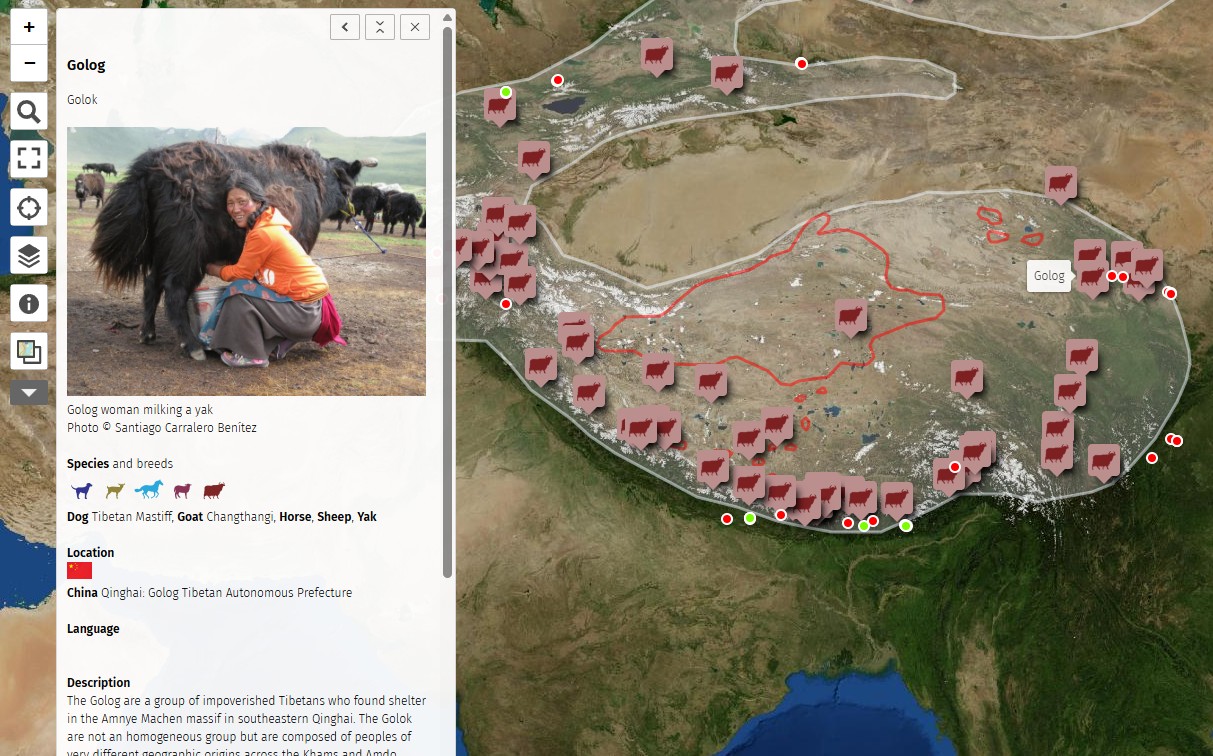
Our new world map of yaks shows around 70 pastoralist groups who keep yaks and nearly 50 organizations that are involved in yak research, development and support. The map also shows the approximate range of the domesticated yak (Bos grunniens) as well as the distribution of wild yaks (Bos mutus). Yaks are central to pastoral livelihoods in the cold, high mountains and plateaus of Central Asia, where few other livestock can thrive. There are about 14–15 million domestic yaks worldwide, with over 90% in China; Mongolia has around 600,000, with smaller populations in Bhutan, India, Kyrgyzstan, Nepal, Pakistan, Russia and Tajikistan. Yaks provide milk, butter and cheese, meat, wool and fibre, hides and skins. They are used as pack animals as well as for riding and draught power. Their dung is used as fertilizer and is an important fuel where wood is scarce. Yaks have also been introduced to North America, Europe and New Zealand, where they are also used for landscape maintenance. Special thanks to Professor Lóng Ruìjūn of Lanzhou University, China, for the initial idea for this map and for providing much of the information on which it is based. The world map of yaks is one of a series of maps of pastoralism prepared by the League for Pastoral Peoples and Endogenous Livestock Development. Other maps include pastoralist groups, threats to pastoralism, migration routes, videos on pastoralism and camelids.