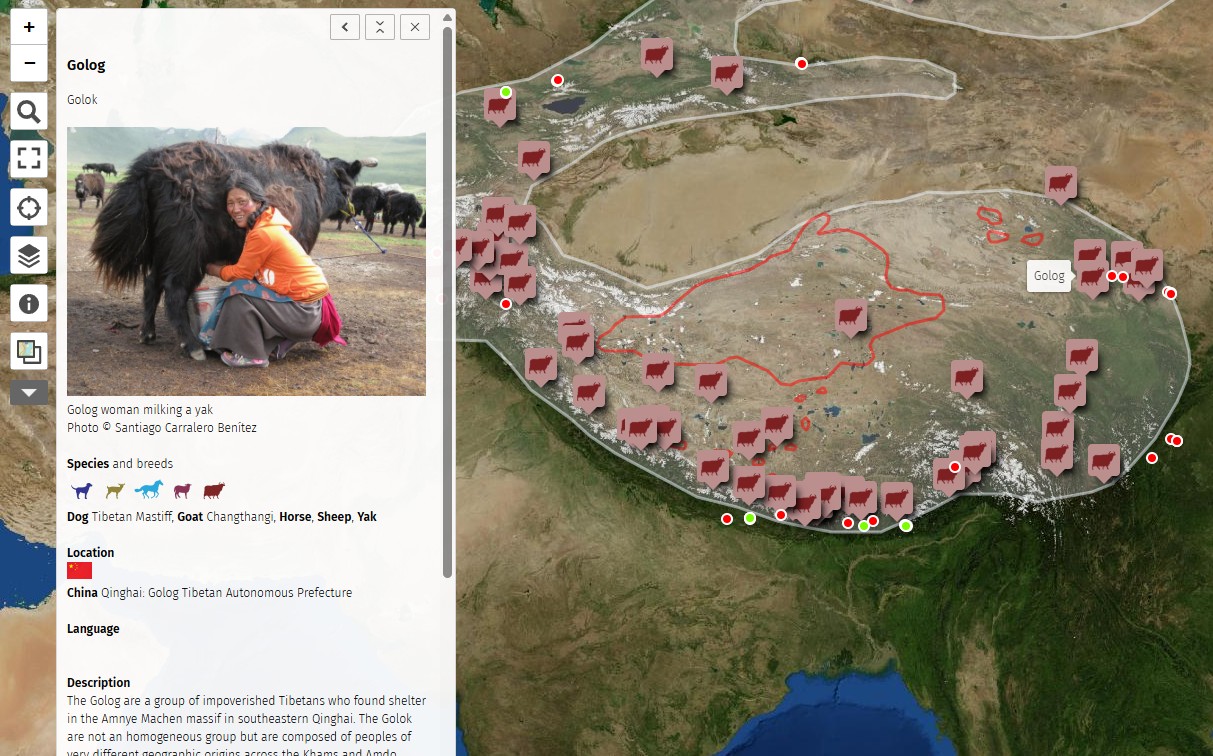
World map of yaks

Yaks are central to pastoral livelihoods in the cold, high mountains and plateaus of Central Asia, where few other livestock can thrive. There are about 14–15 million domestic yaks worldwide, with over 90% in China; Mongolia has around 600,000, while smaller populations occur in Bhutan, India, Kyrgyzstan, Nepal, Pakistan, Russia and Tajikistan. Yaks provide milk, butter and cheese, meat, wool and fibre, hides and skins. They are used as pack animals as well as for riding and draught power. Their dung is used as fertilizer and is an important fuel where wood is scarce. Yaks have also been introduced to North America, Europe and New Zealand, where they are also used for landscape maintenance. Our new world map of yaks shows around 70 pastoralist groups who keep yaks and nearly 50 organizations that are involved in yak research, development and support. The map also shows the approximate range of the domesticated yak (Bos grunniens) as well as the distribution of wild yaks (Bos mutus). Special thanks to Professor Lóng Ruìjūn of Lanzhou University, China, for the initial idea for this map and for providing much of the information on which it is based. The world map of yaks is one of a series of maps of pastoralism prepared by the League for Pastoral Peoples and Endogenous Livestock Development. Other maps include pastoralist groups, threats to pastoralism, migration routes, videos on pastoralism and camelids.

New dossier: We need pastoralists! How herders and farmers sustain fertile landscapes

This 20-page dossier, published by Misereor in collaboration with the League for Pastoral Peoples, DiTSL, the Foundation for Ecological Security and Welt-Sichten, focuses on how herders and farmers collaborate to sustain fertile landscapes. An estimated half a billion people worldwide depend on pastoralism for their livelihoods. Pastoralists keep around one billion animals, accounting for around half of the world’s livestock. They make a significant contribution to food security and the economiy by supplying milk, meat, hides, skins, and live animals for both domestic consumption and export.. Their mobile livestock production system enhances biodiversity on rangelands and sustains their function as carbon sinks. Pastoralism is one of the oldest forms of production known to humankind. An estimated half a billion people worldwide depend on pastoralism for their livelihoods. If we include those who process or market livestock products as well as urban consumers, up to two billion people benefit directly or indirectly from pastoral production. Pastoralists keep around one billion animals, accounting for around half of the world’s livestock. They make a significant contribution to food security by supplying valuable protein (milk, meat) while contributing both to the export of live animals, hides, and skins and to national value creation in their respective countries.Furthermore, their mobile livestock production system enhances biodiversity on rangelands and sustains their function as carbon sinks. Despite this impressive track record, the public knows little about pastoralists.Reports about pastoralists are often full of myths and prejudices. While the media frequently reports on conflicts between settled farming communities and herders, it rarely reports on the often close relationships between these groups that have developed over time or these groups’ mutual exchange and peaceful coexistence. The present publication aims to mark the International Year of Rangelands and Pastoralists (2026) by filling this gap. The introductory article seeks to familiarise readers with the complex world of pastoralists. Part 2 provides an overview of the diverse synergies between pastoralist and farming communities in India by highlighting the relationship between farmers and herders. For example, manure from pastoralist production ensures that we can enjoy organic coffee from India. Part 3 explores how peaceful coexistence is possible in Nigeria’s politically charged climate and how pastoralist and farming communities in Tanzania refuse to be divided despite restrictive government policies. The publication concludes with suggestions from a conference in Nairobi and conclusions from the editorial team. Download English German

Mapping threats to pastoralists webinar now online

The International Year of Rangelands and Pastoralists is drawing much needed attention to pastoralists and celebrates their crucial contribution to the conservation of nature and food security, as well as their ethical relationship with livestock. But pastoralists are losing an ever-increasing amount of their customary grazing areas. In response, we are adding a new component to our Pastoralist Mapping Project: a map that illustrates and monitors the threats that pastoralists experience. Its success will depend on crowd-sourcing information from the ground. This event will provide information on how everybody, including those who are concerned themselves, can contribute. Click here for the threats map. Click here or on the image below to view the full webinar. Clcik here for the presentation of the threats map. https://youtu.be/0qg8L1Ju0Ek

Presentation on threats to pastoralism

Click on the image above or here to download. Presentation by Paul Mundy to launch the "Threats to pastoralism" map, 5 June 2026. Click here for the threats map. Click here to view the full webinar that launched the map.